UJPO 100th Anniversary Report
UJPO’s 100th anniversary was celebrated in a big way on Thursday, June 25 in Winnipeg. The theme Joy and Struggle was represented through rousing musical performances, the history of our storied organization and through our determination to continue fighting for social justice.
The evening’s agenda included performances by the talented musical group The Shandes from Toronto - UJPO’s own David Wall and Sarena Sarain, accompanied on violin by Winnipeg musician and conductor Kaitie Reider. Katie led the North End Jewish Folk Choir in a series of songs that ran the gamut of its repertoire, ending with respect, with a tribute to the fighters of the Warsaw Ghetto uprising through the song Zog Nit Keyn Mol. We enjoyed and appreciated the collaboration with Toronto in organizing our event. It was wonderful working with Shayle Kilroy, David, Sarena and the many Ujpo members who came in from Toronto.
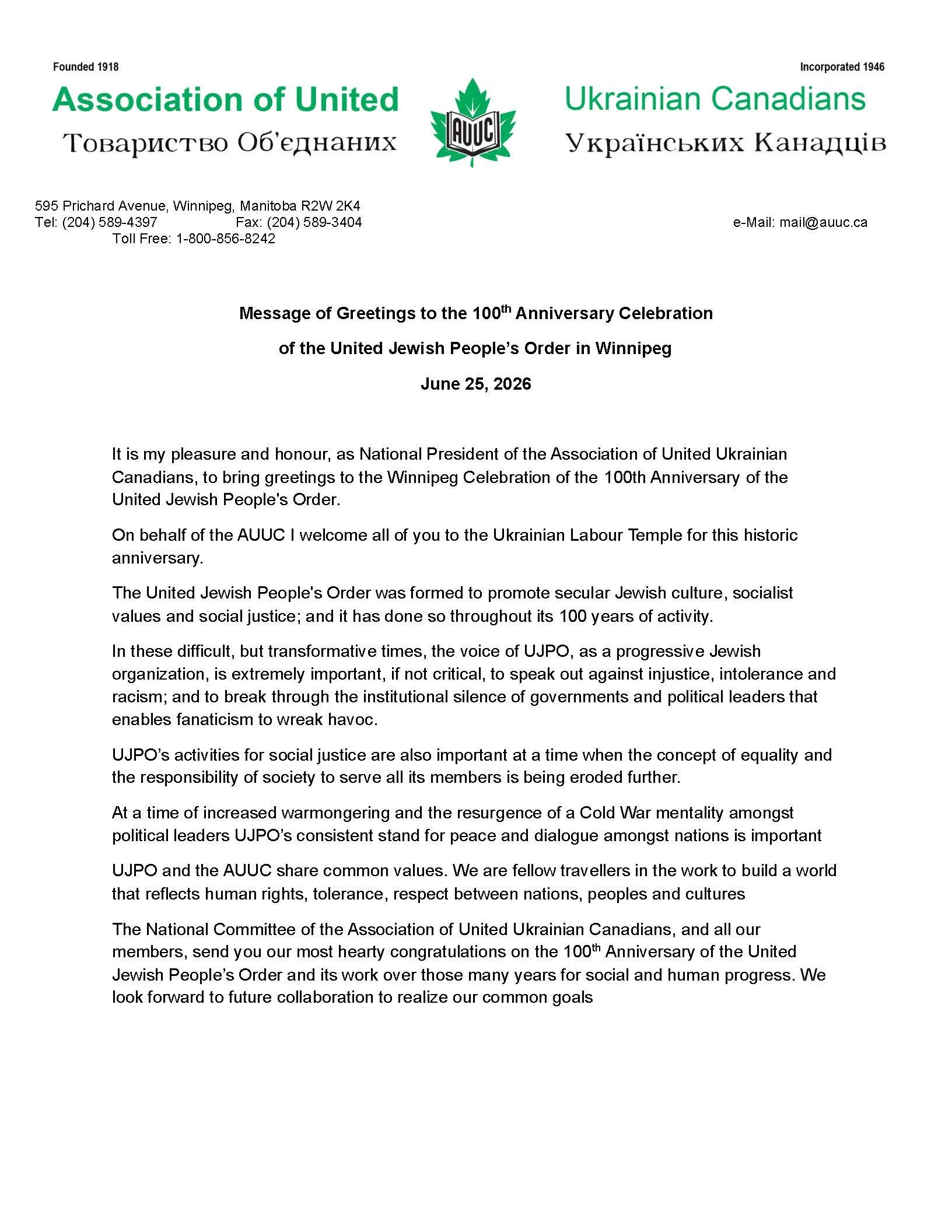
Ellen Karlinsky and Harriet Zaidman shared the emcee duties, with Harriet providing a history of UJPO's century of activism, listing the many activities and events in support of social justice carried out under the UJPO banner - not all of them, because no one could remember all of them. Greetings were offered by former National President of the Canadian Union of Public Employees, Paul Moist, and the president of the Association of United Ukrainian Canadians (AUUC), Glenn Michalchuk. See the attached speeches.
We were honoured to have in attendance Abbie Bakken from the UJPO National Board, along with other members of the Palestine Content Advisory Committee for the Palestine Uprooted: Nakba Past and Present exhibit. They received a rousing and supportive reception from the UJPO National Board and other members of the Palestine Content Advisory Committee for the they received from those in attendance.
The celebration took place in a fitting location - the Ukrainian Labour Temple, a symbol of the unity between progressive groups in the Jewish and Ukrainian communities since our forebears arrived in Canada at the turn of the 19th century.
The nearly 100 people who attended the celebration cheered our most recent accomplishments in standing up to demand justice for the Palestinian people, to rebuffing the pressures exerted by the legacy Jewish organizations, most recently standing up to demand justice for the Palestinian people. Inspired by our history, motivated by our present, we pledged to continue fighting for social justice, to honour the legacy of those who began UJPO.
100th Anniversary Speech - Harriet Zaidman
The roots for the United Jewish People’s Order in Winnipeg go back to the time when socialist-minded individuals took part in the labour and social upheavals in Tsarist Russia and who took inspiration from the October Revolution in 1917. They came here as Bolsheviks, Marxists, socialists, social-democrats, Bundists, anarchists, Zionists, labour Zionists and others, and were thrown into the working class milieu, most of them exploited as immigrants and workers in the place they had come to for a better life.
With their experiences and their secular, political consciousness to guide them, they joined the struggle for better wages and working conditions, most working class Jews took part in the 1919 General Strike.
The radical movement splintered and joined, and with a rupture in the Workman’s Circle in 1926, those who were internationalist, working class Jews came together to found the Liberty Temple, later named the Sholem Aleichem Centre, on Pritchard and Salter, It had a Yiddish School and promoted Yiddish language activities. When the branch of UJPO was formalized in 1945,the building became the its home..
When the branch was formed, there were three distinctive groups:
The Men's Branch (they looked after the finances so UJPO in Winnipeg could exist) among other things).
The Women's group, which organized reading circles and public functions. They invited known Jewish authors from other parts of Canada & beyond to come to Winnipeg to speak to their book clubs. UJPO organized speakers, debates, lectures - continuing the lively, creative, humanist traditions and veltlechkeit - secularism that enriched Jewish life.
And there was a Youth Division, which formed a choir that performed the cantata "The Lonesome Train" composed by Earl Robinson, a contemporary of renowned opera singer and civil rights campaigner Paul Robeson, with Robinson in attendance at the performance. They held dances, public seders, and mounted the play Barkochba in Yiddish which was performed at the Playhouse before a full house of1200 people. UJPO had a children’s camp at Husavick that kept the Youth division busy.
The youth were raised to adopt adult concerns. The Jewish Anti-Fascist League was an effective force in raising consciousness among Winnipeg Jewry and the broader community about the implications of anti-semitism as the beginning of an attack on all democratic rights, a deliberate effort to sow dissension among those who should be united against capitalist exploitation.
During World War II, progressive Jews raised money for the “Aid to Russia” movement to send materials and goods to the besieged Red Army and the Soviet people after Hitler’s armies invaded the Soviet Union in 1941.
The revelations of crimes under Stalin shocked many members, causing some to leave. The pressures of the Cold War - surveillance by the RCMP and red-baiting also resulted in a loss of membership. UJPO renounced support for the Soviet Union in 1958, but it continued to advocate as a socialist-oriented, secular organization supporting those struggling against imperialism and oppression.
UJPO members in Winnipeg took part in marches, rallies, conferences, etc. for civil rights in the U.S., against the War in Vietnam, in support of the Cuban people’s revolution, against the arming of the contras in Central America, against nuclear armaments, against the war in Iraq, for the expulsion of Nazi war criminals from Canada, in support of indigenous rights, for better wages and working conditions. In the 1970s, UJPO Winnipeg was the first to call for Holocaust studies in the educational curriculum. The list goes on to include support for LGBTQ+ and trans rights, and to the forums held on issues of local importance and events organized to promote Yiddishkeit. Most significantly, we are a progressive voice in the Jewish community, calling for justice for the Palestinian people, condemning the genocide perpetrated by Israel. We have linked arms with Palestinian comrades to show our solidarity with their struggle.
For many years we were a small group, with long-term members keeping the branch alive - among others - Doreen Dolgoy, Morry and Lil Zeilig, Fred Narvey, Dora and Harry Rosenbaum, Dan Brudy and Larry and Roz Usiskin. Roz was our intellectual and spiritual inspiration. Everyone who knew her feared what she would say at every meeting, “What else can we do?” because she knew we could - and should, always do more. She was never satisfied, and we carry on, remembering her drive to do better, to help make the world a better place.
The genocide in Gaza has brought new members to our chapter - Jews and non-Jews who want a home that stands for the best in our community. We have a vibrant choir - the North End Jewish Folk Choir, a book club, a literary discussion group and now we sponsor secular Passovers and Hanukah celebrations - a continuation of the work done for many years by the Sholem Aleichem Community, which devolved from UJPO, to celebrate Jewish festivals and educate youth.
We encourage you to join us, to take out memberships - you don’t have to be Jewish, as our membership shows, you have only to support our progressive values. We need your support and your passions to add to the richness and diversity of our organization, to reach the many people who do not agree with the positions of the dominant Jewish organizations, to show Winnipeggers and Canadians that we stand on the right side of history, that we are keeping alive the flame of justice that our forebears lit when they fought for truth, unity, justice and reconciliation - and a better world.
Paul Moist Speaking Notes
100th Anniversary of UJPO
June 25th, 2026
Good evening, it is a great honour to bring greetings on this important celebration of the centenary of the United Jewish People’s Order. I have over the course of my trade union career, had the good fortune to know and work with many progressives from UJPO.
It’s difficult in a few short minutes to relay the connections between labour and the Jewish left in Winnipeg, and I struggled with how to accomplish this. It then came to me, to just share some of my own inter-face with your community over the past half-century.
I think writer Jack Ludwig, quoted in Harry Gutkin’s book, The Worst of Times, The Best of Times, captured the Jewish community he grew up in, here in north Winnipeg when said:
“…the heart of what I must tell you about North Winnipeg is not its places, but its people…a whole generation of Jews who broke away from Orthodoxy – devoutly secular, politically committed to humanitarian causes, reaching out to the world culture and proud of their Yiddish inheritance. These were the people of my childhood.”
My encounters with the progressive Jewish left have been numerous, here are a few examples.
Jacob & Rose Penner
The Penners are featured in the 1919 General Strike Brookside Cemetery Walking Tour that I developed in 2019, the 100th anniversary of the General Strike.
Jake, a member of the Bakery Workers Union, was a member of the General Strike Defence Committee. The Penners home was raided by police as part of the round up of strike leaders.
The Penners, both born in Russia, met in Winnipeg after immigrating here in the first decade of the 20th century. They met in 1908 public lecture sponsored by the Winnipeg Radical Society, the speaker that evening was Emma Goldman.
Jake Penner served almost 30 consecutive years on Winnipeg City Council, his service interrupted only due to his interment in an Alberta camp, his crime, his membership in the Communist Party.
Their son Norman Penner wrote Winnipeg 1919: a Definitive History of the Winnipeg General Strike. Another son, Roland, whom I knew well, served as a cabinet member in the Pawley government and as Dean of the Faculty of Law at the University of Manitoba.
Jake Penner’s political longevity is a legacy of the General Strike. The Stike was smashed by the state and was no victory for the workers of the day, but those workers supported their leaders electing many of them to all levels of government, over and over.
Political Diversity
The left in Winnipeg was united in the 1919 General Strike, which saw 35,000 workers, a third of whom did not belong to a union, walk off the job for six weeks in support of building and metal trades workers fight for collective bargaining rights.
When it came to politics, the unity was not so evident. Some were members of the Socialist Party of Canada, the forerunner to the Communist Party. Other were members of the Social Democratic Party of Canada, loosely put, a forerunner to the CCF/NDP. Yet others were members of the Independent Labour Party.
In the 1923 civic election, General Stike leaders, Helen Armstrong, Edith Hancox and Thomas Flye, ran against each other in Ward 2 (the Weston / Brooklands area).
Joe Zuken
Zuken served over 40 years at the school board and municipal levels, a stellar electoral record by this champion of the poor and marginalized. I met Joe in the late 70’s, he was a friend of all workers, including the civic employees local I belonged to at the City of Winnipeg.
When he passed away in 1986, friends established the Joseph Zuken Memorial Trust Fund administered by the Winnipeg Foundation. I served as a Trustee of the Fund for its first two decades. It is here where I met many members of UJPO and the progressive Jewish left.
Between 1990 and 2017 the Zuken Fund awarded just over $140,000 in grants, to a range of organization including, Canadian Jewish Outlook magazine (26), the Jewish Heritage Centre of Western Canada; CCPA-MB; the Sholem Aleichem Cultural Group and numerous other groups.
The Fund today is administered by the CCPA-MB and has supported research into the annual State of the City Report, and other critical inner-city research.
Roz Usiskin, an active member of UJPO and prominent researcher. I recall fondly, Roz speaking about the progressive Jewish left and the General Strike, alongside Harriet Zaidman in a 2019 event at the Rady Centre.
When Roz passed in 2022, Ellen Karlinsky reached out to me for a few sentences to post in memory of Roz, and I wrote to her, saying: “As a trade union leader, I valued Roz as an ally and a mentor. Most importantly, I valued her clarity of thought, her progressive values and her friendship.”
Fred Narvey, a noted writer and activist, recalled for me how the General Strike and the Spanish Flu pandemic affected his family. He joined Joe Zuken’s progressive Arts Club in the early 1930’s. In 1934 Fred was Chair of the Jewish Anti-Fascist League, and he was part of group, alongside labour activists who gathered in Old Market Square and blocked fascists who planned to march through Winnipeg, after this near-riot the fascists never again tried to march in the city.
Abe & Bertha Arnold were both active in the Zuken Association, I attended their home for meetings often. Both were staunch human rights activists. Abe headed up the Manitoba Association for Rights and Liberties. Bertha was a lifelong CCF/NDP member and worked as an assistant to Saul Miller, a member of Ed Schreyer’s cabinet. They taught me that labour rights are human rights and no society could call itself truly democratic without extending human rights to all citizens.
Leon Mitchell was a huge player in the labour movement in Winnipeg for 40-plus years. He was fired for organizing a union at Western Glove. At age 25 he returned to school to get his Grade 12. He worked as a full-time Business Agent for the Federation of Civic Employees, the forerunner to my union, CUPE Local 500. In 1952 he led the union to secure the 40-hour work week, with no loss in pay plus, a healthy wage hike.
In 1954, at 38 years of age, he enrolled in the Faculty of Law at the University of Manitoba. He practiced law for union’s only alongside Sid Green and Sam Minuk. He gave his practice to Mel Myers in the early 60’s when he moved into a role as an arbitrator and prominent vice-chair of the Manitoba Labour Board.
Mel Myers. Myers was Manitoba’s most prominent labour lawyer from 1962 – 2002. He co-founded the Canadian Association of Labour Lawyers. He was to me, a mentor and a dear friend, he passed away just a few short months ago. He was an active member of the Western Canadian Jewish Historical Society.
David Orlikow was a long-serving NDP MP for Winnipeg North, he also served as a school trustee and for four years as a CCF member of the Manitoba Legislature.
He was a dear friend of mine, and of all workers. In 1994 when we celebrated the 75th anniversary of the General Strike, one event was held here in the Ukrainian Labour Temple, a meeting of the CLC executive, a dinner and the staging a play commissioned to commemorate the General Strike. It was David’s first time entering this building, owing to the political divides of era.
Daniel Stone, many of you know Dan Stone as a prominent historian and active member of the Jewish community. I first met him at an important conference held in the city in 2001, Jewish Radicalism in Winnipeg, 1905 – 1960. His book on the conference, Jewish Life and Times, Volume VIII is required reading for those wanting to understand the progressive Jewish left in Winnipeg and its relations with the labour movement.
In 2022 Dan contact me and a group of us, including Sid Rabinovich, Lionel Steiman and Stan Carbone worked to raise some money and stage the play, Waiting for Lefty. In the midst of the COVID pandemic, we pulled this off and were able to pay actors their union rate at a time when work for them was scarce.
So, in closing, I have been blessed over the past 50 years to have met and worked with so many activists from the Jewish left. I congratulate the United Jewish People’s Order on a century of activism and wish you all the best as you embark on your next century.
We are living in strange times and it has always struck me that reaching out to embrace relations with other progressives beyond the labour movement made me a better trade unionist, and labour as a whole stronger.
We should all heed the words of Professor Ruth Frager who spoke at the 2001 Jewish Radicalism conference, where she said, “Times have changed but not the essential challenge of building meaningful solidarity while protecting human diversity.”
Thank you for the opportunity to bring greetings, and Happy 100th Anniversary.